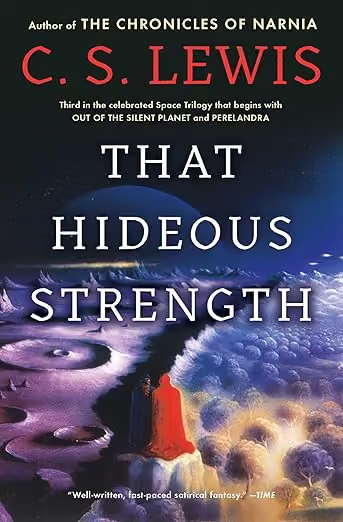
What C.S. Lewis explores philosophically in The Abolition of Man, he articulates through fiction in That Hideous Strength. Indeed, in the final chapter of the philosophical work, Lewis proposes that the elimination of moral objectivism, combined with humankind’s thirst to obtain power over nature, will merely result in some having power over others. As he asserts, “the power of Man to make himself what he pleases means, as we have seen, the power of some men to make other men what they please” (Lewis, The Abolition of Man, 59).
That Hideous Strength envisions a world of this very kind, with unbridled technological advancement leading to the control of some and their attempt to redefine what it means to be human. Through the main characters of Mark and Jane Studdock, along with the opposing institutional forces of the National Institute of Co-ordinated Experiments (N.I.C.E.) and the loosely organized communal group at St. Anne’s, the novel delves into themes of humanity’s thirst to master nature, transhumanism, what it means to be human, and the intersection of the spiritual and material world. While the novel is the third in Lewis’s “Space Trilogy,” it can be read independently.
Join staff from the Center for Bioethics & Human Dignity for an in-person roundtable discussion of Lewis’ That Hideous Strength. Those who sign up will be offered a complimentary copy of the book (in digital or hard copy format).
Who: All TEDS staff, faculty, and students are invited.
What: A shared discussion of Lewis’ That Hideous Strength.
Where: Lee Fireside Room
When: Wednesday, December 3, 12:00 PM – 1:30 PM
This is intended as a shared discussion amongst friends. CBHD staff will guide the discussion, but bring your own questions and insights. Light refreshments will be provided.
Book Synopsis: “A sinister technocratic organization is gaining power throughout Europe, with a plan to “recondition” society, and it is up to Ransom and his friends to stop this threat by applying age-old wisdom to a new universe dominated by science. The two groups struggle to a climactic resolution.”